
If you’ve ever found yourself Googling at 2am trying to figure out why your baby is crying, arching, or uncomfortable, you’re not alone.
Parents are often told it’s just gas, just reflux, or just colic.
And while those labels are common, they don’t always tell the full story.
Because here’s the truth:
Babies deserve to feel good in their bodies, and you deserve to enjoy this season, not just survive it.
First, Let’s Reframe the Question
Instead of asking:
“Is this colic, reflux, or gas?”
I encourage parents to ask:
“What is my baby’s body trying to tell me?”
In my work with infants, I don’t start with labels.
I start with the body.
Is there tension?
How is the nervous system functioning?
What do feeding mechanics look like?
Is baby working harder than they should during feeds?
Because many of the babies I see who are labeled with reflux or colic are actually struggling with something deeper, and very treatable.
What I See All the Time (And What Might Surprise You)
1. “Reflux” that improves without medication
I frequently work with babies who have been diagnosed with reflux - and while reflux can be physiological, symptoms often improve dramatically when we:
Reduce body tension
Improve oral motor skills
Adjust positioning at the breast and/or bottle
When feeding becomes more efficient and the body is more regulated, babies often become significantly more comfortable.
2. “Colic” that’s actually a dysregulated system
Many parents are told:
“It’s just colic, they’ll grow out of it.”
And while time does help, that doesn’t mean nothing can be done.
In my experience, babies labeled as “colicky” are often:
Holding significant body tension
Struggling with state regulation
Having difficulty settling and organizing
And when we support their nervous system and body, things start to shift.
What’s Actually Normal?
Let’s take a deep breath here, because not everything is a problem.
Physiological Reflux (Normal)
Many babies experience what’s often called “happy spit-up,” including:
Frequent spit-up
Minimal distress
Normal weight gain
These babies are typically thriving and do not require medical treatment.
When It’s Worth a Closer Look
Some signs suggest your baby may benefit from additional support:
Poor weight gain
Persistent distress during feeds
Excessive spit-up, gas, and/or discomfort
Feeding refusal
If you’re seeing these, it’s worth digging deeper - not just managing symptoms, but understanding why they’re happening.
How to tell the difference between colic, reflux, and gas
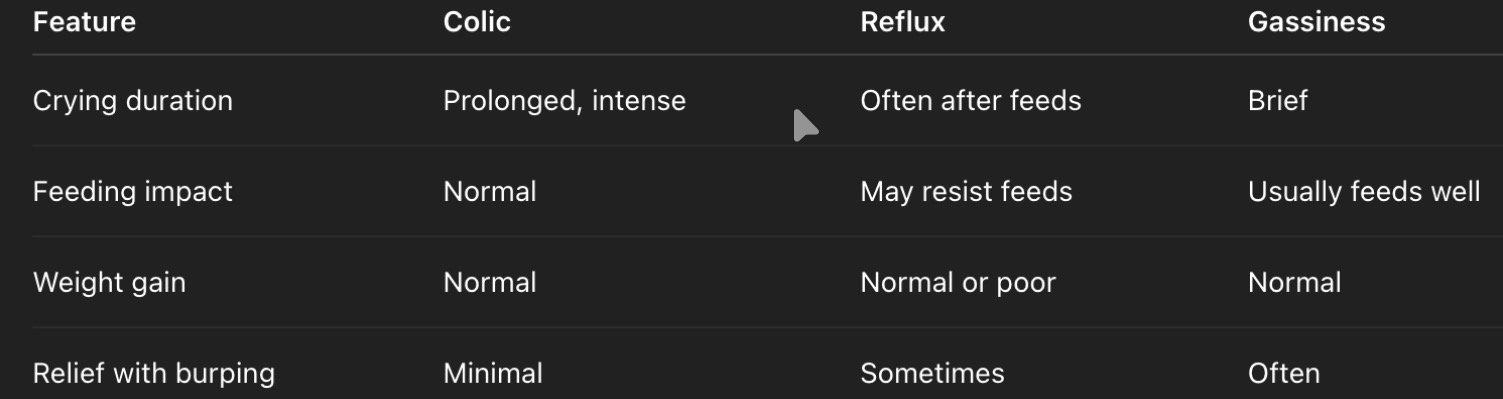
Image Courtesy of B.Well Tots
What I Wish Every Parent Knew
You don’t have to struggle through this alone
Your baby deserves to feel good in their body
You deserve to enjoy the newborn phase, not just survive it
Many common recommendations act as band-aids, not root-cause solutions
Digestive challenges are often temporary, but support can make a huge difference in the meantime
Understanding what’s normal (and what’s not) can bring so much peace and confidence
What You Can Do Right Now
If your baby seems uncomfortable, here are a few ways to start supporting them immediately:
Support Feeding Mechanics
Try a semi-upright feeding position
Make sure nipple flow matches your baby’s pace
Pause frequently for burping
If bottle feeding, consider paced feeding to reduce air intake
Use Movement to Support Regulation
The body and nervous system are deeply connected.
You can help your baby by:
Incorporating gentle movement throughout the day
Allowing for tummy-down positioning while awake
Using responsive, cue-based handling instead of rigid schedules
Parents often notice their baby becomes more comfortable when feeding and movement are aligned with their natural rhythms.
A Final Reassurance
If you’re in this stage right now… it can feel overwhelming.
But most babies do not stay here forever.
With time, development, and the right kind of support, many babies outgrow reflux, gas, and colic-like symptoms.
And in the meantime, there are ways to help them feel better.
You Don’t Have to Guess - Support for Babies in Blanchard, OK & Surrounding Areas
If you’re a parent in Blanchard or nearby communities like Norman, Moore, Newcastle, Tuttle, Mustang, or Chickasha - you don’t have to navigate reflux, gas, or colic alone.
While many families are told to “wait it out,” there are more supportive, body-based approaches available that can help your baby feel more comfortable now.
If you’re unsure whether what you’re seeing is normal, or you just want a second set of eyes on your baby’s feeding, movement, and comfort, you don’t have to figure it out alone.
Learn more about how I work with families on my infant physical therapy services page.